问题一:. 如何在用REST API获取活动日志时,控制输出的项?
【答】参考REST API对于获取活动日志的说明接口,在参数是**$filter和$select中可以分别控制过滤条件和输出项**
GET https://management.chinacloudapi.cn/subscriptions/{subscriptionId}/providers/microsoft.insights/eventtypes/management/values?api-version=2015-04-01&$filter={$filter}&$select={$select}
注:management.chinacloudapi.cn为中国区Azure的管理终结点,management.azure.com为全球Azure的管理终结点
URI Parameters
| Name | Description |
|---|---|
| $filter | Reduces the set of data collected. This argument is required and it also requires at least the start date/time. The $filter argument is very restricted and allows only the following patterns. - List events for a resource group: $filter=eventTimestamp ge '2014-07-16T04:36:37.6407898Z' and eventTimestamp le '2014-07-20T04:36:37.6407898Z' and resourceGroupName eq 'resourceGroupName'. - List events for resource: $filter=eventTimestamp ge '2014-07-16T04:36:37.6407898Z' and eventTimestamp le '2014-07-20T04:36:37.6407898Z' and resourceUri eq 'resourceURI'. - List events for a subscription in a time range: $filter=eventTimestamp ge '2014-07-16T04:36:37.6407898Z' and eventTimestamp le '2014-07-20T04:36:37.6407898Z'. - List events for a resource provider: $filter=eventTimestamp ge '2014-07-16T04:36:37.6407898Z' and eventTimestamp le '2014-07-20T04:36:37.6407898Z' and resourceProvider eq 'resourceProviderName'. - List events for a correlation Id: $filter=eventTimestamp ge '2014-07-16T04:36:37.6407898Z' and eventTimestamp le '2014-07-20T04:36:37.6407898Z' and correlationId eq 'correlationID'. NOTE: No other syntax is allowed. |
| $select | Used to fetch events with only the given properties. The $select argument is a comma separated list of property names to be returned. Possible values are: authorization, claims, correlationId, description, eventDataId, eventName, eventTimestamp, httpRequest, level, operationId, operationName, properties, resourceGroupName, resourceProviderName, resourceId, status, submissionTimestamp, subStatus, subscriptionId |
在Filter和select可以配置的每一项说明,请查看文末的附录一。
问题二:是否可以往Data Lake中注入Json格式文件?
【答】根据官方文档示例,如果使用Databricks进行(SQL查询语句)进行数据分析,是支持Json格式的数据,示例中使用的Json格式如下图所示:
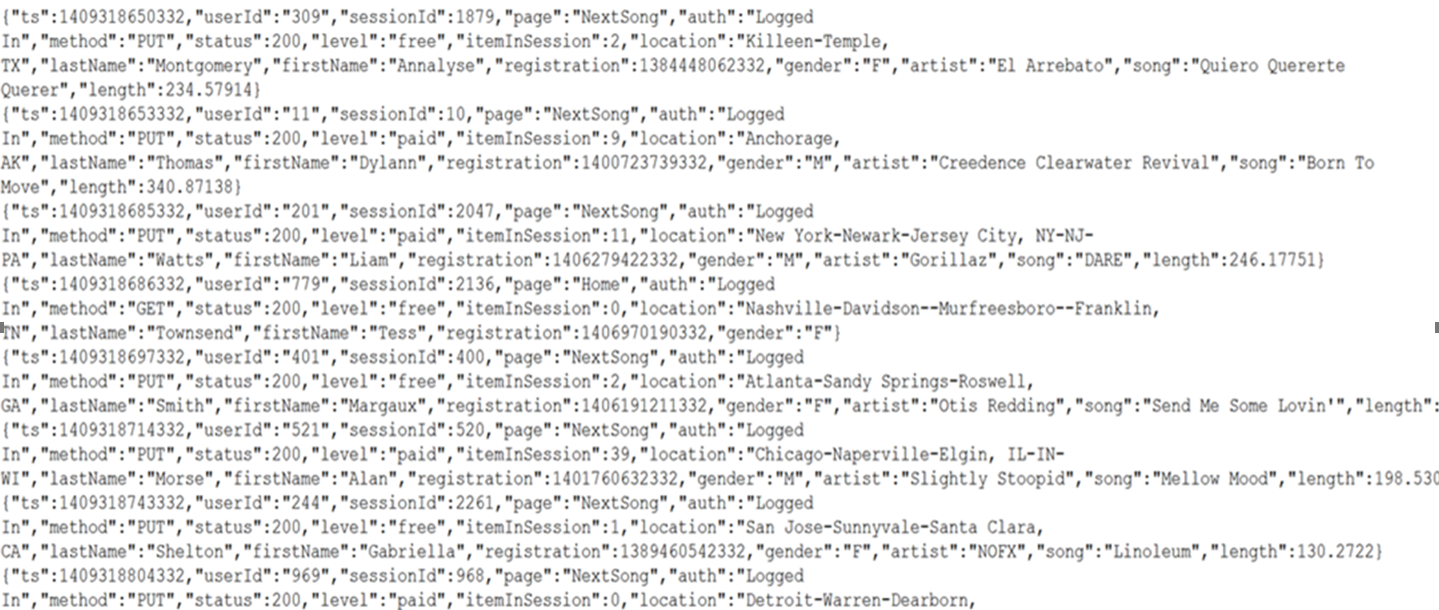
参考使用 Databricks 分析数据一文: https://docs.azure.cn/zh-cn/storage/blobs/data-lake-storage-quickstart-create-databricks-account#ingest-sample-data
问题三:如何用C#向Data Lake中插入数据文件?
【答】可以,需要先安装 Azure.Storage.Files.DataLake NuGet 包。然后添加如下引用
using Azure.Storage.Files.DataLake;
using Azure.Storage.Files.DataLake.Models;
using Azure.Storage;
using System.IO;
using Azure;
将文件上传到目录,则参考以下代码即可:
通过创建 DataLakeFileClient 类的实例,在目标目录中创建文件引用。
通过调用 DataLakeFileClient.AppendAsync 方法上传文件。
确保通过调用 DataLakeFileClient.FlushAsync 方法完成上传。
public async Task UploadFile(DataLakeFileSystemClient fileSystemClient)
{
    DataLakeDirectoryClient directoryClient =
        fileSystemClient.GetDirectoryClient("my-directory");

    DataLakeFileClient fileClient = await directoryClient.CreateFileAsync("uploaded-file.txt");

    FileStream fileStream =
        File.OpenRead("C:\\file-to-upload.txt");

    long fileSize = fileStream.Length;

    await fileClient.AppendAsync(fileStream, offset: 0);

    await fileClient.FlushAsync(position: fileSize);

}
完整实例参考使用 .NET 管理 Azure Data Lake Storage Gen2:https://docs.azure.cn/zh-cn/storage/blobs/data-lake-storage-directory-file-acl-dotnet#upload-a-file-to-a-directory
附录一:在$Filter和$select可配置的选择项的EventData属性
The Azure event log entries are of type EventData
| Name | Type | Description |
|---|---|---|
| authorization | SenderAuthorization | The sender authorization information. |
| caller | string | the email address of the user who has performed the operation, the UPN claim or SPN claim based on availability. |
| category | LocalizableString | the event category. |
| claims | object | key value pairs to identify ARM permissions. |
| correlationId | string | the correlation Id, usually a GUID in the string format. The correlation Id is shared among the events that belong to the same uber operation. |
| description | string | the description of the event. |
| eventDataId | string | the event data Id. This is a unique identifier for an event. |
| eventName | LocalizableString | the event name. This value should not be confused with OperationName. For practical purposes, OperationName might be more appealing to end users. |
| eventTimestamp | string | the timestamp of when the event was generated by the Azure service processing the request corresponding the event. It in ISO 8601 format. |
| httpRequest | HttpRequestInfo | the HTTP request info. Usually includes the 'clientRequestId', 'clientIpAddress' (IP address of the user who initiated the event) and 'method' (HTTP method e.g. PUT). |
| id | string | the Id of this event as required by ARM for RBAC. It contains the EventDataID and a timestamp information. |
| level | EventLevel | the event level |
| operationId | string | It is usually a GUID shared among the events corresponding to single operation. This value should not be confused with EventName. |
| operationName | LocalizableString | the operation name. |
| properties | object | the set of <Key, Value> pairs (usually a Dictionary<String, String>) that includes details about the event. |
| resourceGroupName | string | the resource group name of the impacted resource. |
| resourceId | string | the resource uri that uniquely identifies the resource that caused this event. |
| resourceProviderName | LocalizableString | the resource provider name of the impacted resource. |
| resourceType | LocalizableString | the resource type |
| status | LocalizableString | a string describing the status of the operation. Some typical values are: Started, In progress, Succeeded, Failed, Resolved. |
| subStatus | LocalizableString | the event sub status. Most of the time, when included, this captures the HTTP status code of the REST call. Common values are: OK (HTTP Status Code: 200), Created (HTTP Status Code: 201), Accepted (HTTP Status Code: 202), No Content (HTTP Status Code: 204), Bad Request(HTTP Status Code: 400), Not Found (HTTP Status Code: 404), Conflict (HTTP Status Code: 409), Internal Server Error (HTTP Status Code: 500), Service Unavailable (HTTP Status Code:503), Gateway Timeout (HTTP Status Code: 504) |
| submissionTimestamp | string | the timestamp of when the event became available for querying via this API. It is in ISO 8601 format. This value should not be confused eventTimestamp. As there might be a delay between the occurrence time of the event, and the time that the event is submitted to the Azure logging infrastructure. |
| subscriptionId | string | the Azure subscription Id usually a GUID. |
| tenantId | string | the Azure tenant Id |
正在加载评论...